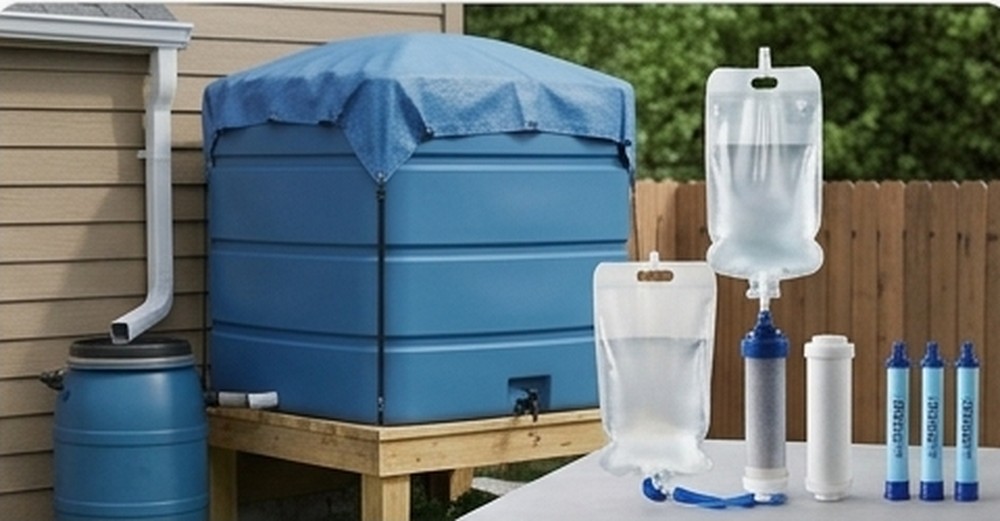
Every Drop Counts
Food shortages take weeks to become dangerous. Water shortages take days. It's the single most important thing to get right, and the one most households have the least of.
★ Our Pick: Sawyer Mini Water Filter (SP128) →How Much Water You Actually Need
The standard figure is one gallon (about 4 litres) per person per day, for drinking and basic hygiene combined — and that's a minimum, not a comfortable amount. It doesn't cover washing dishes, laundry, or a garden. For a genuine two-week buffer, a family of four needs roughly 220 litres just for the essentials.
- 2 litres per person, per day, for drinking alone in normal conditions
- Add more in hot weather, for pregnant or breastfeeding people, and for illness
- Don't forget pets — they need water too, and it's easy to plan for the humans and forget the dog
Calculator: How Much Water to Store
Storing Water Long-Term
Tap water stored correctly keeps essentially indefinitely — it's the container and the light exposure that cause problems, not the water itself.
- Use food-grade containers only — old milk jugs break down and taint the water; proper water storage containers or drums don't
- Keep containers away from direct sunlight, which encourages algae growth even in sealed containers
- Rotate stored tap water roughly every 6-12 months as good practice, even though properly stored water lasts far longer
- A mix of container sizes helps — large drums for bulk storage, smaller bottles for anything you need to carry or move
Collecting More When Supply Runs Low
Storage covers the first stretch. Beyond that, you need a way to bring in more.
- Rainwater harvesting from a roof and guttering into a water butt is the simplest large-volume source most homes can set up
- A water butt with a first-flush diverter keeps the worst roof debris out before it reaches storage
- Know your nearest natural water sources — a stream, pond, or river — and treat that water as unsafe until filtered and purified, never drink it raw
Filtration & Purification
Collected or questionable water needs treating before it's safe to drink. These aren't interchangeable — filtration removes particles and many pathogens, purification kills what's left:
- Boiling for one minute (three at altitude) kills essentially all pathogens — the simplest, most reliable method if you have a heat source
- A portable water filter (hollow-fibre or similar) removes bacteria and protozoa without needing power or fuel
- Purification tablets or unscented household bleach (a few drops per litre) handle viruses a filter alone might miss
- For the most questionable sources, combine methods — filter first to remove particles, then boil or treat chemically
Signs Water Isn't Safe
Cloudiness, an odd smell, or an unusual colour are all reasons to treat water before drinking, even if it looks mostly fine. When in doubt, treat it anyway — the cost of over-treating is a few minutes; the cost of under-treating is getting sick at the worst possible time.
Shop This Kit
Emergency Water Kit